Inflatable barriers for pipelines, intelligent water flow control
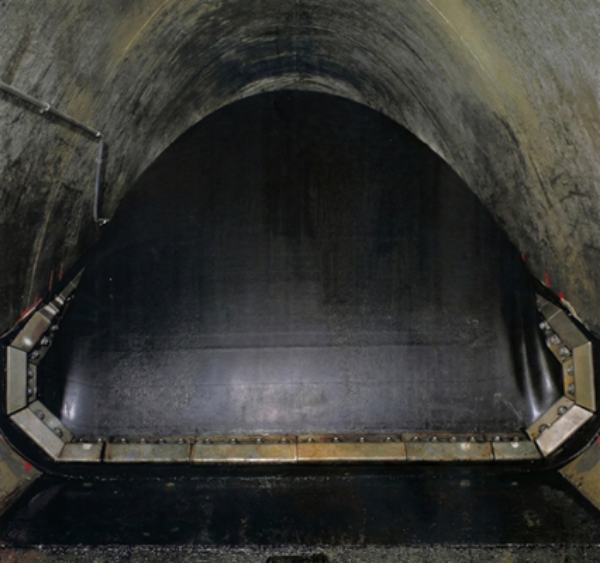
The Hydro Air Bank Expan Gate is a low-pressure, inflatable barrier designed to regulate water flow in pipelines and tunnels. Made from heavy-duty, nylon-reinforced rubber fabric, the bladder is secured in place using a robust anchoring system.
Operating at pressures up to 6 psi, the Expan Gate uses standard air blowers and valves to inflate the bladder, so it conforms to the tunnel profile. An automated control system continuously monitors one or more water-level sensors and based on preset logic, incrementally inflates or deflates the bladder to maintain desired water levels during storm or surge events.
The Expan Gate integrates with standard communication protocols such as SCADA, enabling remote monitoring and control from centralized systems. Local manual override is available for on-site operator intervention when needed, ensuring secure, reliable operation under all conditions
Dry conditions
Inflatable gates for drainage systems allow water flow to be regulated in a flexible and controlled manner according to network conditions. The images show the system under dry conditions, both in the deflated state allowing free water passage and in the inflated state, where the gate adapts to the tunnel to control flow accurately and safely.
Deflated
Inflated
Wet conditions
Inflatable gates for drainage systems allow water flow to be regulated in a flexible and controlled manner during heavy rainfall events. The images show the system under rainfall conditions, where the gate inflates progressively to adapt to the tunnel and manage flow accurately, helping to prevent network overloads and overflows.
Design considerations
Structural tests must confirm pipes can be embedded in the tunnel wall. Expan Gates with pipes embedded in the bench require careful management.
Ensure a large enough manhole is near the installation site.
Design pressure: 4.0 psi.
Uneven deflation occurs without a water-head if unassisted. Even deflation and flat-rest achieved with a high-water head. Recommendation: A vacuum pump is advised (not mandatory) to pull the gate flat when deflating without water head.
It is recommended to install a failsafe UPS system sized to operate the control panel, valves, water-level sensors and pressure transducers for up to 2 hours.
A UPS helps ensure the Expan Gate can deflate in the event of power loss during high-water conditions.
Valves are designed to fail open automatically if power is lost, while under normal conditions they remain closed unless actively modulating water levels.
If UPS power is unavailable, valves will open and the gate will deflate as a safety measure.
Bladder inner pressure should track upstream water level to minimize pressure in the Expan Gate.
Gate can operate in partially inflated positions for extended periods.
Crude water-level control is possible.
Normal design inflation time: ~30 minutes.
Deflation time depends on pipe size and sewer flow. A vacuum blower can be supplied to remove remaining air and help the bladder lay flat.
If there isn’t a constant flow through the sewer, the gate is typically kept fully inflated at minimal inner pressure (just enough to lift the top sheet) to eliminate time required for filling the gate.
Expan Gate can be fully inflated following a storm.
Common outfall design:
Gate at 50% inflation until upstream water level (USWL) rises.
Inflates to 100% and holds until max desired USWL is reached.
Modulates height to maintain max USWL during storm.
Returns to 50% inflation after water recedes.
It is possible to hold water under pressure in the tunnel (surcharging). The maximum head the gate can resist is 7 meters.
Upper storage limit is pre-determined by gate design.
Expan Gate typically kept deflated or at very low pressure to avoid bladder stretching.
Possible to surcharge tunnel (hold water under pressure). Max tested head: 4 m (13 ft) from tunnel base (likely higher but subject to testing).
Tailwater from tidal changes may require Expan Gate to remain above 50% inflation for extended periods (special design considerations apply).
Possible to drain upstream water by step-by-step deflation.
Standard: 2 regenerative blowers supplied for inflation.
If design pressure exceeds capacity of two regenerative blowers, one positive displacement blower can be supplied instead with an uploader valve.